
Hands-On Learning for Toddlers Why Experiential Play Builds Early Skills

A toddler can learn a surprising amount from a bowl of water, a few measuring cups, and a towel on the floor. Pouring, splashing, scooping, and spilling may look like simple play, but it is also early science, motor practice, language growth, and problem-solving all at once. Hands-on learning is a core element of our curriculum here at Smiles Academy, our new daycare in Bethpage, New York, and here is why.
That is the truth about hands-on learning for toddlers. It is not just “keeping them busy.” Experiential play gives young children a way to test ideas with their bodies and senses before they can fully explain those ideas with words.
Toddlers are still building the mental tools they need to compare, predict, remember, plan, and communicate. Hands-on activities meet them where they are. Instead of asking a 2-year-old to sit still and absorb information, experiential learning invites them to touch, move, try, repeat, and discover.

Toddlers learn best when they can do, not just watch
Toddlers are active learners. They do not separate learning from movement, touch, sound, or emotion the way adults often do. When they stack blocks, smear paint, carry a basket, or stir pretend soup, they are taking in information from many sources at once.
Hands-on learning works well in early childhood because it connects three things:
Action
Sensory input
Meaning
A toddler who drops a ball again and again is not trying to annoy anyone. They are learning cause and effect. A child who insists on fitting the same puzzle piece in the same wrong spot may be testing shape, size, and persistence. A toddler who pours dry pasta from cup to cup is learning volume, sound, coordination, and control.
This kind of learning also fits the toddler attention span. Young children often return to the same activity in short bursts. They explore, leave, come back, and try again. That repetition helps the brain build stronger connections.
Hands-on play also creates natural motivation. A worksheet asks for attention from the outside. A sensory bin, block tower, or mud pie invites attention from within. The child wants to find out what happens next.
Hands-on activities build thinking skills in real time
Cognitive growth in toddlerhood includes memory, attention, problem-solving, early logic, language, and flexible thinking. Hands-on activities support these skills because they turn abstract ideas into real experiences.
A toddler does not need a formal lesson on gravity to learn that a tower falls when it gets too tall. They do not need a lecture on weight to feel that a bucket full of rocks is harder to lift than a bucket full of leaves.
Cause and effect becomes visible
Toddlers learn cause and effect through repeated action. They push a button and hear a sound. They squeeze play dough and see it flatten. They knock down blocks and watch pieces scatter.
These moments teach a basic but powerful idea: my actions can change what happens.
That idea supports later problem-solving. A child who learns to test actions safely is practicing the early form of scientific thinking. They wonder, try, observe, and adjust.
Memory grows through repetition
Many toddlers love doing the same activity again and again. Adults may find this tiring, but repetition helps children remember patterns.
When a toddler completes the same shape sorter several times, they start to remember which shape fits where. When they sing the same action song each morning, they learn sequence. When they help feed a pet, wash hands, or put shoes near the door, they build routine memory.
Memory becomes stronger when the body is involved. A child may remember “twist the lid” better after doing it than after hearing the instruction alone.
Problem-solving becomes hands-on
A basket is too heavy. A block tower keeps falling. The lid will not fit. The toy car is stuck under the couch.
These small challenges matter. They give toddlers chances to plan and adapt. Should they use two hands? Try a different block? Ask for help? Pull instead of push?
Adults can support this by pausing before stepping in. A few seconds of struggle, when safe and not overwhelming, can be useful. It gives the toddler space to think.
Try simple prompts such as:
“What else could we try?”
“That piece is tricky.”
“You turned it. Now what happens?”
“You worked hard on that.”
These comments support thinking without taking over the task.

Sensory experiences are not extras
Sensory play sometimes gets treated as a messy bonus, but it plays a central role in early learning. Toddlers use their senses to gather information before they can describe it clearly.
They learn through:
Touching rough bark, smooth stones, sticky dough, and soft fabric
Hearing water splash, bells ring, paper crinkle, and blocks clack
Seeing colors mix, shadows move, and objects disappear under scarves
Smelling herbs, soap, flowers, or warm food
Moving their bodies through climbing, crawling, pushing, pulling, and dancing
These experiences help toddlers sort and organize the world. They begin to notice categories such as wet and dry, heavy and light, loud and quiet, soft and hard, warm and cold.
Sensory experiences also support language. A child who has felt sticky glue, cold ice, or bumpy bubble wrap has a real memory attached to those words. Language becomes more meaningful when it connects to experience.
A toddler can memorize the word “smooth,” but touching a smooth stone gives the word a home.
Sensory play supports self-regulation
Hands-on sensory activities can also help toddlers manage energy and emotions. Some children calm down when they scoop rice, knead dough, or push a laundry basket. Others need movement, such as jumping, carrying, climbing, or dancing.
This does not mean sensory play fixes every hard moment. Toddlers still have big feelings. But sensory experiences can give them healthy ways to use their bodies and settle their attention.
Good sensory play does not need to be complicated. A pan of oats, a sponge at the sink, a cardboard box, or a basket of fabric squares can offer rich learning.
Safety matters, especially for toddlers who still mouth objects. Choose items that are age-appropriate, supervise closely, and avoid small pieces that could be choking hazards.
Effective hands-on learning activities for toddlers
The best toddler activities are simple, open-ended, and easy to repeat. They do not need to look perfect. In fact, activities that allow many possible outcomes often teach more than activities with one “right” result.
Here are practical examples that support early development.
Water play with cups and spoons
Set a shallow bin of water on a towel or take the activity outside. Add cups, spoons, funnels, small bowls, or bath toys.
Toddlers practice pouring, filling, emptying, and comparing. They learn words like full, empty, more, less, splash, sink, and float.
Keep water shallow and stay within arm’s reach. Even small amounts of water require close supervision.
Play dough and simple tools
Offer play dough with child-safe tools, such as plastic cookie cutters, craft sticks, rolling pins, or large buttons for pressing.
This builds hand strength, coordination, creativity, and vocabulary. Toddlers can roll snakes, make balls, press textures, or pretend to cook.
For a simple homemade option, many families use flour-based dough recipes. If allergies are a concern, choose materials that fit the child’s needs.
Sorting everyday objects
Use safe household items such as socks, large lids, blocks, toy animals, or fabric scraps. Invite toddlers to sort by color, size, type, or texture.
They may not sort the way an adult expects, and that is part of the learning. A toddler might put all “favorite” items in one pile or all noisy items together. Ask gentle questions:
“How did you choose those?”
“Which one feels soft?”
“Can you find another blue one?”
Sorting supports early math because it builds comparison and classification.
Nature walks with collecting
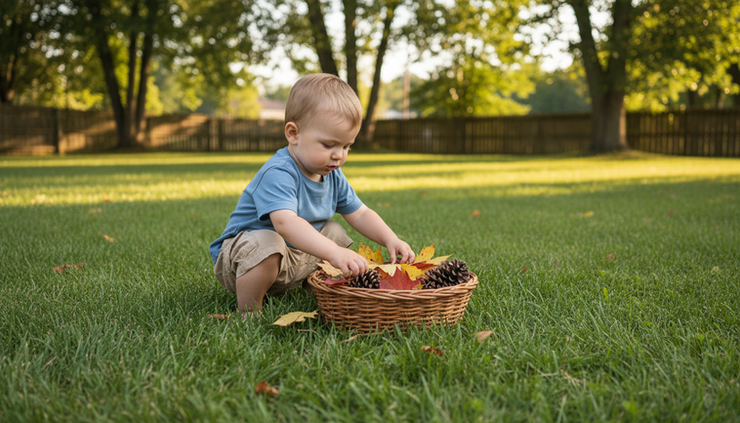
A short walk can become a hands-on lesson. Look for leaves, pinecones, sticks, rocks, flowers, puddles, or shadows. Bring a small bucket, or simply look and talk.
Nature offers rich sensory learning. Toddlers can compare textures, notice sounds, and observe living things. They can learn to be gentle with plants and insects.
Try a simple “find” game:
Find something round.
Find something that crunches.
Find something green.
Find something tiny.
Find something that moves.
This builds attention and observation without needing formal instruction.
Pretend cooking
Set out a bowl, wooden spoon, measuring cups, and soft play food or safe real items like large lettuce leaves or orange peels. Toddlers can stir, scoop, serve, and pretend to taste.
Pretend play supports language, memory, sequencing, and social understanding. A child may copy routines they see every day, such as making soup, pouring coffee, or washing dishes.
Narrate the sequence:
“We put it in the bowl. Now you stir. Now you give me a bite. Yum, it is crunchy.”
Building with blocks and boxes
Blocks, cushions, paper towel tubes, and cardboard boxes invite problem-solving. Toddlers can stack, line up, fill, dump, hide, and build enclosures.
This supports spatial awareness. Children learn about height, balance, inside, outside, over, under, near, and far.
Boxes are especially useful because they can become houses, boats, tunnels, garages, or beds for stuffed animals.
Art that focuses on process
For toddlers, art is more about exploration than finished products. Finger painting, sponge painting, tearing paper, sticking tape, and scribbling with chunky crayons all count.
Process art teaches toddlers that marks, colors, pressure, and movement create change. It also supports fine motor skills and choice-making.
Use washable materials, cover the surface, and keep expectations realistic. A toddler may paint the paper, the table, and one elbow. That is normal.
The parent’s role is to guide without controlling
Hands-on learning does not require adults to act like teachers all day. It works best when adults create safe chances to explore, then stay nearby with warm attention.
A helpful role is part observer, part guide.
Watch what the child is trying to do. Are they filling containers? Lining things up? Wrapping toys in blankets? Climbing on cushions? Their interest can guide the next activity.
If a toddler loves pouring, offer bath cups or a dry pouring tray with large pasta. If they love transporting, give them a basket and safe objects to carry. If they love hiding, play peekaboo with scarves or create a simple tunnel.
Use language that follows the action
Talk during play, but avoid turning every moment into a quiz. Too many questions can interrupt concentration.
Instead of asking, “What color is this? What shape is this? How many are there?” all at once, try describing what is happening.
Say things like:
“You made a tall tower.”
“The red cup is full.”
“That sponge feels wet.”
“You pushed hard, and the car went far.”
“The dough is flat now.”
This gives toddlers useful words while keeping the play natural.
Let mess have limits
Messy play can be valuable, but it does not need to take over the house. Boundaries make hands-on learning easier to offer often.
Try these simple limits:
Use a tray, towel, bin, or washable mat.
Keep messy play in the kitchen, bathroom, porch, or yard.
Offer small amounts of materials at first.
Dress the child in clothes that can get dirty.
Keep wipes or a bowl of water nearby.
Teach cleanup as part of the activity.
Cleanup is also hands-on learning. Toddlers can wipe a table, toss scraps, put blocks in a basket, or carry towels to the laundry.
Rotate materials instead of buying more
Toddlers do not need a room full of toys to learn well. Too many choices can make play scattered. A small set of open-ended materials often works better.
Useful items include:
Blocks
Cups and bowls
Scarves or fabric squares
Large cardboard tubes
Chunky crayons
Play dough
Toy animals or people
Large pom-poms for supervised play
Baskets and containers
Cardboard boxes
Put out a few items at a time and rotate them every few days. The same blocks feel new when paired with animals one day and cardboard ramps the next.

How to encourage experiential learning at home
A home that supports experiential learning does not need to be fancy. It needs time, safety, and permission to try.
Start with everyday routines. Toddlers often love real tasks because they see adults doing them. A child can help match socks, rinse vegetables, stir batter, water plants, feed a pet with help, or wipe a spill.
These tasks build confidence because they have real purpose. They also build coordination, sequence, and language.
Try these habits:
Offer choices
Give two simple options, such as “Do you want blocks or play dough?” Choice builds independence without overwhelming the child.
Slow down when possible
Toddlers learn more when they have time to repeat an action. If a child wants to buckle and unbuckle a doll stroller five times, that repetition has value.
Follow curiosity
If a toddler is fascinated by shadows, make hand shadows on the wall. If they love wheels, roll cars down ramps. Interest fuels attention.
Ask open-ended questions
Use questions that invite thinking, such as “What do you think will happen?” or “How can we make it stand?”
Celebrate effort
Praise the process more than the result. “You kept trying” supports persistence better than “That is perfect.”
Build in movement
Toddlers need to move. Carrying, crawling, pushing, jumping, balancing, and climbing all support body awareness and brain development.
Keep screens from replacing real exploration
Digital content can show ideas, but toddlers still need touch, movement, and face-to-face interaction. A video of mixing colors cannot replace the feeling of swirling blue and yellow paint together.
What hands-on learning is not
Experiential play is powerful, but it is sometimes misunderstood.
It is not a demand to entertain toddlers every minute. Boredom can lead to creativity. A child who has safe materials and time may invent their own play.
It is not always quiet or tidy. Real exploration can involve noise, spills, and repetition.
It is not about pushing academics earlier. Toddlers do not need flashcards to have rich learning experiences. Early math, science, language, and problem-solving can grow through blocks, songs, stories, sorting, cooking, and outdoor play.
It is also not a free-for-all. Children still need limits. Throwing sand, dumping water on the floor, or putting small objects in the mouth needs calm, clear guidance.
A useful phrase is, “You can pour water in the bin. Water stays in the bin.” This teaches the boundary while keeping the learning available.
The real value is stronger foundations
Hands-on learning gives toddlers direct experience with how the world works. It helps them build cognitive skills, sensory awareness, language, motor control, confidence, and persistence.
A toddler stacking blocks is not just stacking blocks. They are learning balance, planning, patience, and the joy of trying again. A child stirring pretend soup is not just making a mess. They are practicing sequence, imitation, motor control, and storytelling.
The best starting point is simple. Choose one activity that fits the child’s current interest. Put out a few safe materials. Watch what they do. Add a few words. Let them repeat.
That is where early learning often begins, not in a perfect lesson, but in the steady rhythm of touching, trying, wondering, and discovering.


Comments